Showing posts with label british. Show all posts

7/04/2011

Middlemarch (1994)


Let's talk about George Eliot for a minute. She was an incredibly cheesy, muckraking author who created decent characters, but moralized to the point of beating a dead horse. I'm drawing these conclusions on a reading of Silas Marner from high school. This novel is all about orphans and misers who learn lessons and opium addicted mothers. I pretty much threw up all over this novel when I read it. This is why I know I will never read Middlemarch. The miniseries version was saccharine enough, even with screenwriter Andrew "kind of makes 19th Century novels sexy" Davies throwing in some extra bits to chew on.

So, as far as I can tell from the miniseries (I was doing useful things like doing laundry and baking cookies during the proceedings), the story is all about a small town, Middlemarch, on the cusp of industrialization. There's lots of small town drama and of course young people hooking up all over the place--and by hooking up I mean making hasty marriages.

First you have Dorothea Brooke who is a nerdy girl who wears glasses and thinks for herself. For reasons I can only attribute to repressed Victorian sexuality, she marries a nerdy middle-aged confirmed bachelor (wink wink) who is dedicated a book about mythology. But instead of being cool and letting Dorothea help him write his book, he belittles her and ignores her in the bedroom, confirming my suspicion that this guy is totally gay.

So anyway, being married to her closeted husband is really boring and she slowly wastes away, but his cousin Will Ladislaw takes an interest in her. He's a passionate and accomplished young man, though indecisive to his career. Ladislaw and Dorothea have fun conversations in which they talk about ideas and get sassy with each other. Blah blah blah, Secret Homosexual hates his cousin and has screwed him over in regards to wealth just as the rest of his family has done in the past, blah blah blah, he dies and gives all his money to Dorothea with the condition that she not marry Ladislaw. But it turns out Ladislaw is in love with her! WHAT WILL HAPPEN NEXT? Not much. Their scenes together are rare.

And that right there is the most interesting story line.

Another involves some doctor who marries a kind of silly girl and then spends too much money on a house and other things while trying to start up a hospital where doctors actually do doctorly things and not sell ineffective tonics. Drama, gambling, and marital fighting happen.

And then there's the brother of the silly girl who just sucks at everything and has some since-childhood-girlfriend who is awesome and sassy and tells him to get a job he likes to earn a living.

And then there's random other stuff that was moralizing that had to do with pious people not really being that pious in their actions. And the common man getting the vote. And way too many characters and uncles to care about.

But I think the real take-away message here is that Rufus Sewell as Will Ladislaw in the 1994 production is dreamy. Why haven't I seen him as a romantic lead more often? I mean, I guess I've seen him in those roles on occasion, but this one is a more straight forward ROMANTIC LEAD. He gets to represent idealism and handsomeness instead of quirkiness, all while still darting his eyes around. If nothing else, Mr. Sewell is a welcome breath of fresh air to a miniseries that gets bogged down in...I don't even know, I was too busy eating cookie dough by the end.

In a smiliar spirit to my celebration of Terence Stamp in Far From the Madding Crowd, here's a gallery of poor quality images of Rufus Sewell I captured for your enjoyment. And, Spoiler alert:

Checking out Dorothea for the first time.


Sitting on a stoop, plotting to visit Dorothea while chewing on a pencil.


He tosses around his gloves as the discussion gets more heated.


In which he becomes a speech writer for Dorothea's uncle's Parliament run.


Flirtatious face.


Angrily crumpling up a letter his cousin sent him, banning him from seeing Dorothea.


Being all, "Your husband told me never to see you again. I'm so mad!"


Answer me this: why are guys scratching to back of their necks so hot?


Singing with the doctor's silly wife. At least he has a couple friends.


Ladislaw giving an impassioned audience-warm-up speech. Yay, bloodless revolution!


Emo-ly confessing his love without actually confessing his love because this is a 19th century novel, and they could never actually say anything in a straightforward manner. Also, Dorothea is wearing a hideous mourning bonnet/cap.


This is his "are kidding me?" face. I know, bro. She totally doesn't get that you are MEANT TO BE.


This is his "it says WHAT in my cousin's will?" face.


Angrily packing.


Intense look of love.


Uh-oh, Dorothea caught him with his arm around the doctor's silly wife. She's totally jelly.


Reading a letter that everything has been straightened out with Dorothea.


19th Century Male Lead Walking Determinedly Through Garden (TM).


Making out with Dorothea whose eyes are still open for some reason.

FIN.

11/01/2010

PBS is lovely

Because it reminded me how adorable Rupert Graves is (you're still looking good, you silver fox). He plays the boss to the crazy and caustic Sherlock Holmes on House Sherlock. No really, it's basically House with British accents. Mix in some Martin Freeman as Doc Watson and of course I'm watching this.

9/18/2009

Much Ado About Nothing

In recent years, I have taken to repeatedly viewing Kenneth Branagh's 1993 film adaptation Much Ado About Nothing. It's as close to romantic comedy perfection as possible. Taking place in Italy, a household containing the patriarch Leonato (Richard Briers), his innocent and lovely daughter Hero (Kate Beckinsale), Hero's maidservant Margaret (Imelda Saunton), and Hero's saucy and staunchly single cousin Beatrice (Emma Thompson). They are visited by some soldiers fresh from war, the prince Don Pedro (Denzel Washington), the young and lovelorn Claudio (Robert Sean Leonard), the joking and bachelorific Benedick (Kenneth Branagh), and Don Pedro's bastard brother (literally and figuratively) Don John (Keanu Reeves). So pretty much everyone ever is in this movie.

Anyway, the plot is that Claudio wins the love of Hero through the kindly Don Pedro (7th grade style). To kill time in the week interrum before they marry, Don Pedro proposes a plan to get Beatrice and Benedick together. Awesome hijinks ensue. But then Don John is still all bitter about his life situation and jealous about Claudio, so he plans to ruin the wedding. Things get real at the wedding (this is a romcom!), and eventually a death is faked (thanks, Shakespearean priest!). Michael Keaton plays the gross and tedious Dogberry who ends up clearing up the whole misunderstanding, and then there is a celebratory dance!

The overarching story line doesn't interest me so much as the fun Beatrice/Benedick plot. They start off bickering and disagreeing in a fun witty banter sort of way. They exchange insults, and don't hide their dislike for each other. At the masked party (of course), it's revealed that Beatrice and Benedick have some sort of past where Benedick didn't quite love Beatrice as much as she loved him. Apparently things have been hilariously antagonistic ever since. Anway, the rest of the gathering conspires to get them to fall in love. They do this by making sure they are overheard in turn by Benedick and Beatrice talking about how much the other loves them, but how they're too proud to reciprocate. B&B's responses are to prove the conspirators wrong be requiting the love.


How quickly Don Pedro bounces back from Beatrice's refusal. And how awesome his plan is.

As evidenced by his many cinematic forays into the Bard's works, Branagh is one of the few actors that give Shakespearean speech prosody and nuance that sounds familiar to modern audiences. It's really easy to start zoning out when actors start delivering lines in a lovely cadence that shows off the iambic meter, but tends to blur all the words together. But Mr. Branagh actually delivers the lines as if he's expressing the ideas rather than just the beauty of how they are expressed. And Thompson is a very close second in this adaptation, being so sassy with her words.

In fact, the whole cast does a nice job of expressing things in a more conversational way. And as ridiculous as it is to cast Keanu Reeves in Shakespeare, he does an adequate job, mostly in the form of keeping an angry face to match his angry beard. He gets the general ideas across, and does much better when he's not soliloquizing. But overall, the performances are a success.

I could keep extolling the virtues of this movie, including the vibrant lighting and romantic score, but I want to get to the last ShakespeaRe-told adaptation because it was a fabulous.

It starts out with a hint at the backstory between Beatrice and Benedick, with Beatrice (Sarah Parish) being stood up on a date while Benedick (Damian Lewis) hits the road out of town. The story then picks up 3 years later. Beatrice is a local news anchor. Here we meet fair Hero (Billie Piper) and Claude (Tom Ellis) and see their romance start up. But Beatrice's skeevy co-anchor has a bad fall, so Leonard (Martin Jarvis), the boss, decides to bring a former anchor, Benedick, back along with a former director, Peter (Michael Smiley). Also working at the studio is Don (Derek Riddell), a slightly pathetic man who's just been left by his wife and carries a large torch for Hero.

It's actually a fairly faithful adaptation, at least in feeling. Slight changes include the reason Beatrice and Benedick are fooled into loving each other (for the peace of mind of every one who has to work with the bickering pair), simplifying the plot to ruin Claude and Hero's wedding (it's just Don being jealous), cutting down the soldier/security guard parts, and making the ending choices by Hero more realistic and empowering to modern audiences.


When Beatrice "mistakes" Benedick for Claude at the welcome party (in fancy dress of course). Pretty great modern translation, no?

But in the end it's always about Beatrice and Benedick. Sarah Parish is wonderful, playing Beatrice as smart and biting; I do so enjoy seeing sassy women onscreen. And I got a huge kick out of seeing Captain Winters be a sort of sleazy flirt with bad facial hair. Seeing Damian Lewis say "I am horribly in love with her" whilst sliding against a wall makes my life. As made-for-tv contrived the romance is, it comes off well. There are good moments before they fall for each other (thanks to scheming coworkers) that show that they have some things in common, so their liking each other isn't completely out of nowhere. And I just adore a good hate-turned-to-love story.

Anyway, it's worth investigating if you love romantic-comedies as much as I do. Both the 1993 and 2005 version are on YouTube here and here. Enjoy. Watch them back-to-back. You won't regret it.

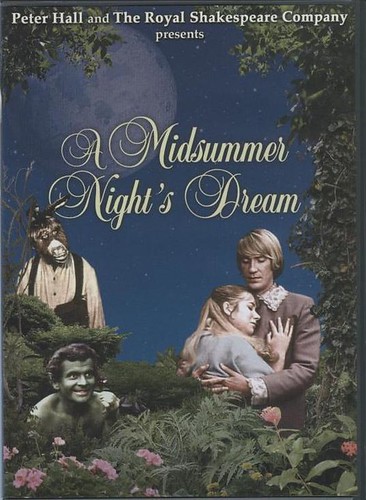
A Midsummer Night's Dream

Welcome back to unofficial Shakespeare week. Let's talk about A Midsummer Night's Dream. It's about 1000 kinds of ridiculous: fairies, broken hearts, love potion, a donkey-man, and a play within a play. But how does one make it more ridiculous?

1. Mismatch male and female costumes. Put the men in vaguely period attire and attach swords. But the women, they must sport 60s dresses with mid-thigh hems and a pair of boots. Also, they must also do nothing with their hair that would be anything but mod.

2. The fairies, let's make them dark green and mostly nude. Except for the children. They can have some clothes.

3. And fairies must move all magically...pray, let's speed up the film slightly and then proceed to record the speech in post-production, but obviously not quite match up the lips. In fact, let's do that to all the speech.

4. And you know what would give it that extra magical feel? Film it on location in a dark, dank forest with extra mud. That way, everything will be the same brown and dark green color.

5. And let's match this minuscule production design budget with world class actors of the Royal Shakespeare Company and get Peter Hall to direct it.

Thus came about the 1968 television adaptation of A Midsummer Night's Dream. It's mostly successful at being entertaining, seeing as how legit actors are delivering their lines like they know what they're saying. It also helps that much of the dialogue is spoken swiftly (one of the benefits of a Shakespeare comedy over a tragedy as they're not trying to make things important by how long it takes them to say something).

Plus, did I mention Judi Dench plays the mostly nude Queen of the Fairies and Helen Mirren is Hermia? Although I believe both of them are upstaged by the unsettling yet awesomely intense performance by Ian Richardson as Oberon the King of the Fairies. Honestly, it's like he was the inspiration for Gene Wilder's Willy Wonka, it is that weird/great.

I'm not sure I can say anything else about how incredible this production is. Do yourself a favor and just watch some highlights of Judi Dench (but look out for Ian Richardson's eyes and the psychedelic editing job):


I hope your brain didn't just explode because now I'm going to talk about the pretty awful (and not in a fun psychedelic way) ShakespeaRe-told version. It's something I would expect to see on ABC Family. I'm not even kidding when I tell you I would rather watch My Fake Fiance again because at least Melissa Joan Hart and Joey Lawerance know they're in a crappy made for TV movie and are fully embracing the tragedy that their respective careers have become (you can see it in their eyes).

The updated version of A Midsummer Night's Dream, however, fails to be whimsical and fun. It kind of loses the magic in all its modernity. The night takes place at a holiday camp in which an engagement is broken off and then lovers are mixed up by love juice (oh, Puck). One odd choice is having the fairies and the mortals interact. Well the father and Oberon do at least, which leads to a superfluous and dorky plot line about bringing the romance back into a long marriage that I guess replaces the play within a play at the end.

Let's all just admit that Oberon is the best part of any adaptation. This time Lennie James got to rock this role.

Helena (Michelle Bonnard) comes off the best in this adaptation because she's less desperate and more sympathetically in love with James (William Ash in the updated Demetrius role). Although taking Helena seriously makes things much more cheesy than outrageously funny. This version also allowed me to see my favorite mambo dancing footballer and mistaken identity brother to the screen (William Ash and Rupert Evans), neither of which are that great of actors, they're mostly just nice to look at. Also, having the donkey-ified dude (Johnny Vegas) do a bad imitation of David Brent's awful/awkard dance from season 2 episode 5 of The Office somehow got a laugh out of me, it was so meta.

Final word: Find the 1968 version on Netflix instant play now. If you're up for it, the Re-told version is on there, too, but I'd probably watch to find My Fake Fiance first. (Found here. You're welcome)

9/16/2009

Macbeth

Watching a filmed stage productions is usually pretty boring (musicals being a pretty consistent exception). Rarely do the performances transcend the screen without the aid of editing, music, sets, anything cinematic. I might as well just listen to an audio recording; and in the case of Shakespeare, listening to a recording is almost just as good since settings and actions are usually vocalized anyway.

I braved such an adaption of Macbeth because I had never seen it and I wanted to watch it online. The 1983 version part of a "Tragedies of Shakespeare" series is okay in the sense that it gave me a good idea of the story (with the aid of sparknotes) and I got to hear all the oft repeated lines that are used so often for other things ("sound and fury"--cochlear implants? "Double, double, toil and trouble"--isn't that an Olsen twins movie? "the weird sisters"--magical Billy Idolesque rock?). Anyway, the Scottish play is pretty creepy, in a power-hungry-ill-gotten-gains-mystical sort of way, and I'm sure if I'd watched a more cinematic version I would have enjoyed it more.

But I loved the ShakespeaRe-told version because it visualized a lot of what Shakespeare revealed with long speeches. In other words, it was a more accessible version for film. And instead of the position as king being the incentive for murder, it's the chance to be the top chef at a 3 star restaurant. James MacAvoy plays Joe Macbeth, a chef whose hard work is overshadowed by his employer Duncan Docherty (who he only refers to as the Scottish Chef, haha). One night, Joe and his fellow chefriend Billy Banquo (Joseph Millson) encounter a trio of garbage men who predict Joe's success as head of the restaurant, but also Billy's son's eventual inheritance of it all.

After Joe recalls the experience to his wife Ella (Keeley Hawes), she ends up convincing Joe that the only way that he'll gain his success is by murdering Duncan (obvs) by using his practiced killing skills as a chef with a knife. Things spiral out of control from there.

But what really pulled things off (besides the presence of James MacAvoy and Richard Armitage(!) as Macduff) was the creepy visuals. Joe starts seeing blood everywhere, most disturbingly the water of his wife's shower. And his wife's guilt is shown in how she repeatedly washes her hands and the steadiness (or lack thereof) of her hand as she applies make-up. Somehow this all worked together. I was impressed by how dark a made for TV movie could be. I also thinks this is a great introduction to the story for anyone unfamiliar, although being able to catch some of the references makes it fun to watch even for those who know the play well.

You can find it on YouTube or Netflix instant play.

9/14/2009

The Taming of the Shrew

The Taming of the Shrew is one of Shakespeare's most ridiculous plays. I read part of it when I was a in a history of performance class as part of this heinous dramaturgy project that later got aborted. I never finished it, mostly out of the laziness of my heart, but also because I find reading Shakespeare plays really boring. Seeing a good production, however, is fun.

But The Taming of the Shrew is probably best seen live. I've never had that pleasure, but the play just cries for an audience to goad on the cruelty of both Katherina and Petruchio.

Elizabeth Taylor and Richard Burton spar in the 1967 film version of The Taming of the Shrew sporting great cleavage and a great beard, respectively.

I'm all for mutual insults. In fact, that's the backbone of many great romantic comedies (see: It Happened One Night, When Harry Met Sally). However, The Shrew takes a much discussed misogynist turn in which Katherina is "tamed" by physical, mental, and emotional torture by Petruchio. I can see that maybe being entertaining if done in a very joking and brash way since Petruchio seems to get genuine amusement out of the whole situation.

Physical domination: eeeeh. Please also note Elizabeth Taylor's intense eye shadow.

However, in a more faithful adaptation of the play seems to require a sudden and unexplained submission to by Katherina to her somewhat lunatic husband Petruchio. In that way, I wasn't quite sure I found Franco Zeffirelli's 1967 film version that amusing so much as mildly disturbing. I think there needed to be a bit more farce for it to be enjoyable, which the oft cut framing device seems to provide.

Anyway, the moral of the story is that it's a fairly outdated play that has always been a little creepy. However, the updated version part of the BBC's ShakespeaRe-told* in 2005 gives enough motivation behind both Katherine and Petruchio.

I find myself attracted to Rufus Sewell in his BAFTA nominated role as Petruchio. Mostly when he says "I want you to have all my babies." But I'm also impressed by how well he wears those boots on his wedding day.

Katherine (the pocked sized Shirley Henderson) is a politician who's goals to move up the ranks are threatened by her frighteningly temper and shrill yelling. Petruchio (Rufus "I'm actually quite endearing" Sewell) seems to have genuine affection for Katherine (in addition to his gold digging which he's rather upfront about), and his lunatic antics seem to be his crazy way to win her over.

That's about a foot difference in height. I find that endearing.

Plus, the ending speech where a woman's duties to her husband are enumerated are also applied to a man to his wife, thus making things more whimsical and less sexist. Although it's still odd.

I think I may be in love with this adaptation. Here's a little taste when our lid finds his pot:


Right? It's just ludicrously cheesy, but made for TV in Britain seems so much classier, right?

End notes: I didn't mention the Bianca and her many suitors storyline, but that's mostly because it's rather dull. Who wants to hear about the popular girl? Not me, unless you make her likable, like in the teen adaptation 10 Things I Hate About You (also, Joseph Gordon-Leavitt being one of the suitors makes that plot more endearing exponentially).

And for the curious both the 1967 and 2005 versions are found on YouTube here and here. Enjoy.

6/27/2009

Two late-90s British Romantic Comedies

I own Sliding Doors (1998) mostly because it was in a $5 dollar bin. It's one of the better films you can get in one of those bins because, while it's no cinematic masterpiece, it's quite enjoyable. It's the perfect movie to put on when you're cleaning or packing or doing laundry. You don't have to pay very much attention except to the parts that are delightful.

Still in her non-British British actress stage, Gwyneth Paltrow plays Helen, a PR expert who gets fired from her job. On her way home after her unpleasant sacking, she misses the train home.But wait! This is a romantic comedy so we also see her barely catch the train (which is helpfully accompanied by magical chimes). From here we see the two paths her life could take: one where she gets home early to find her boyfriend Gerry having sex with another woman, the other where she has to find another, longer way home and misses catching her boyfriend cheating. This moment is also where I tend to either tune out/fast forward through one half of the film. Believe me when I say that the storyline that involves Helen being oblivious to her idiotic boyfriend's antics is 3/4 unbearable. I can't think of a more loathsome character than Gerry; he can't decide which woman he wants and then feels bad about it. We have to hear him talk to himself in the mirror, to his unsympathetic friend, and his lover about it. Kill me now.


The film is really saved by the other half of the film where Helen meets the kind and persistent James (John Hannah). It's a sweet relationship that you get to see build through drinking milkshakes and sculling competitions. And we are even treated to two delightful montages in this story, one of them being a makeover montage where Helen gets a sassy haircut and blonde hair (which is quite helpful thing when they keep switching between Helens).

Sliding Doors
is a good fluff film that's at least half decent. And fairly short (99 minutes), so perfect for deep cleaning the refrigerator.

I happened upon Martha, Meet Frank, Daniel and Laurence* (1998) while perusing Netflix. I ended up watching this because of my love of Joseph Fiennes and Rufus Sewell. But mostly of Joseph Fiennes. Ahem. Anyway, it's a breezy (88 minutes) romcom that involves three childhood friends and the girl who they all fall for.

Martha (Monica Potter) is an American who decides to up and move to England. On plane there, she meets a music producer or something Daniel (Tom Hollander) who is instantly smitten by her, and he tries to woo her through bumping her to first class (through ridiculous means I might add). Daniel tells his friends Frank (Rufus Sewell) and Laurence (Joseph Fiennes) about the girl, and Frank, the drunken, unemployed actor blaggard that he is, discovers her in a park and decides to try to get with her himself she's so lovely. Little do either of them know, Laurence encountered her in the airport and was bullied into giving her a ride into London. This time Martha is the one that's smitten, although Laurence likes her soon enough. The conflict? Martha doesn't know they're all friends! And Daniel and Frank are ignorant of Laurence's involvement since they're both self-centered bastards!

But wait! It's a romantic comedy, so Laurence is obviously telling his psychiatrist neighbor about this whole mess early in the morning!

Whatever. It's an amusing enough movie. Honestly, this is the first time I've probably ever seen Rufus Sewell not play a scorned lover/nobleman. He's quite funny actually. And of course we get to see Joseph Fiennes with his love-stricken look that he does so well. Yes, I'm swooning. So really, it's a movie to watch for the people in it, not necessarily for it's ground breaking cinematic quality.

And as with both of these movies, they at least avoid the most painful romcom tropes (to me): the woman pining after some jerk of a man (Rufus Sewell in The Holiday) and the drunken escape paving the way to love (every other romantic comedy). So good things all around. Plus, it's already been a decade since they've been released, so you can laugh at some of the styles and musical choices while reveling in the fantastic UK accents.

1998 Joseph Fiennes. Wonderful. Oh, and Monica Potter is pretty charming too.


*or, as it was released in the US, The Very Thought of You. What's up with the name change? Does every romantic comedy really need to be named after a song? I'm looking at you Simply Irresistable, Someone Like You, It Could Happen to You, et al. Or was that just the 90s?

6/18/2009

Lost in Austen: Pride and Prejudice once again

Recommended for it's ridiculous value by faithful reader Emmy, tonight I viewed the television miniseries Lost in Austen (2008). A young woman, Amanda, who loves Jane Austen's Pride and Prejudice mostly for the perfect romance between Elizabeth and Darcy finds herself in the setting of that very book sans Elizabeth (they switched times, obvs). She disturbs the path that everyone should have been on to love, and takes turn making things worse and making things fit the Pride and Prejudice plot line. Many meta-hijinx ensue.

The best way I can express how I feel about Lost in Austen is that it's basically Kate & Leopold but longer and about 9234877 times worse because it uses the beloved characters of Jane Austen. Almost every character turns out to be worse and/or the exact opposite of the ones that you find in the book. Why, you may ask? I have no idea, but it never failed to make my roommate and I scream in delight and/or terror at every reveal.

But I think my biggest problem with this miniseries is that it can't decide what it's about. Is it about discovering that what we fantasize about isn't as great as it we dream it to be? Is it about discovering that what you have is good enough? Is it about helping others find their destiny? Or is it about falling in love with ideas and those ideas coming true? And why is there a secret door between a modern London flat and the Pride & Prejudice Longbourn attic? There are too many mixed messages for Lost in Austen to be taken as even a decent made for TV movie. So basically He's Just Not that Into You. At the end of Lost in Austen, it's completely unsatisfying and you end up wondering why you spent the last 3 hours staying up way too late watching it.

But that's not to say my night was completely wasted. I got some good roommate bonding in, mostly in the form of mutual yelling at the TV and writhing in pain. There were also some ridiculous moments that perhaps made me sympathize more with the lead character more than I would like. Case in point (spoiler warning, if you care to watch this), compare this past post to this scene:


I like to pretend I love the dip in the lake scene of the BBC adaptation because it in no way resembles the book and the awkwardness is so palpable, but let's be honest, wet-shirted Darcy = awesome.

Although, what makes Pride and Prejudice so satisfying in the first place is the slow building relationship between Elizabeth and Darcy. It's satisfying and organic. This was just a mess where I didn't know who to root for and who was supposed to be good or bad. For what it's worth, I would have taken this rendition's Wickham. He turns out to be the Rhett Butler of the whole affair (that is to say, very self aware and honest about his own faults and those of others).

Hey, look! It's Mr. Wickham, and he's both adorable and awesome, so stop glaring, Amanda. (via)

So, if you have few hours to spare and don't mind great literature being perverted for mediocre purposed, give Lost in Austen a watch. I would just recommend watching it with Jane Austen loving friends. You don't want to watch this alone; that would just be depressing and as pathetic as the leading lady.

6/07/2009

If the BBC did camp...

...it would be the 2004 miniseries He Knew He Was Right. Adapted by Andrew Davies (Pride and Prejudice, Bridget Jones' Diary, Daniel Deronda), he chose to use Ferris Beuller-esque, talk to the camera soliloquies to get into the character's inner thoughts. The effect is rather fun and often times hilarious.

Although I would never want to read the book because, quite simply, the main characters, the Trevelyans, are both kind of idiotic. The first paragraph of the wikipedia article is quite accurate:
He Knew He Was Right is a 1869 novel written by Anthony Trollope which describes the failure of a marriage caused by the unreasonable jealousy of a husband exacerbated by the stubbornness of a willful wife. As is common with Trollope's works, there are also several substantial subplots. Trollope considered this work to be a failure; he viewed the main character as unsympathetic, and the secondary characters and plots much more lively and interesting. It was adapted in 2004 by Andrew Davies as He Knew He Was Right.

Mr. Trollope was right: the secondary characters are fabulous and extremely entertaining. Here is a run-down of my favorites, some of them played by actors whom I recognize:

1. Bill Nighy plays the trouble mongering Colonel Osborne whose visits to Mrs. Trevelyan cause all the trouble in the first place. Bill Nighy is perfect in a role where his motivations can never really be known since his words and reputation conflict with each other. When he turns to the camera to justify his actions, it's a pleasure and absolutely hilarious.


2. The romance between Nora Rowly and Hugh Stanbury is adorable. Nora is the sister to the Mrs. Trevelyan, but remains gorgeous and calm through the whole ordeal. Probably because Hugh is so awesome and clear-minded as well. They fail to see that the other person is as into them as they are, but that resolves itself quickly enough. One of my favorite moments is when Hugh is trying to flirt with Nora, and Nora won't have any of it, and he starts his own sililoquy with "Damn, damn, damn, damn, damn." Said by a man with a cane is quite endearing.


3. Mr. Glascock is Nora's spurned lover. Well, he politely proposes, is politely refused, and goes on living a rather polite life. He sports a fantastic mustache, and eventually falls in love with an American girl with an implacable accent (is she supposed to be from the South or Midwest, I can't tell). Mostly, any character with any degree of common senese is preferable to the main characters and are automatically a favorite.


4. Mr. Gibson, played by David Tennant, is a town vicar who is initially taken by Dorothy Stanbury, but is rejected. In order for his reputation to be saved, a Mrs. French forces him into an engagemnet to one of the Misses French who he has flirted with for seven years, and both of whom are in love with him. Hilarity between awkward characters ensues, including one of my favorite turn-to-the-camera moments.


5. Jemima Stanbury is the spinster aunt of Hugh and Dorothy, and, much like Diana's spinster aunt in Anne of Green Gables, she is rich and convinced any one who comes near her only loves her for her money. However, she grows fond of the very good and very kind Dorothy, and enjoys the pleasant Brooke Burgess. Adorable.

6. Last are my two favorites, Dorothy Stanbury and Brooke Burgess. They have to be the most amiable characters ever written. Brooke is played by the charismatic Matthew Goode (who I fell in love with here, and am shocked when he's awful). Anyway, Dorothy and Brooke fall in love very quickly and sweetly with plenty of good humor.

In fact, all you really need to see of this miniseries is the following, which only features scenes in which Matthew Goode shows up. It misses some of the pseudo-obstacles for Brooke and Dorothy's relationship (letters written, objections given), but that was all ridiculous anyway:

5/16/2009

Two BBC Miniseries

I don't think I love anything more than a well done period piece, especially in miniseries form. There's rarely a more satisfying love story than those told in 19th Century costume and British accents. This Saturday I watched two, taking short breaks to stretch my legs and catch some sun. In other words, a perfect way to spend my day off.

1. The first one I watched was North & South (2004). I've heard fantastic things about this series for a while, so I had high expectations. They were met. My roommate described it as Pride and Prejudice on steroids. But to be fair, it's quite different than Pride and Prejudice, lacking in the amusing criticism of society and instead going for a harsh criticism of society set in the context of the Industrial Revolution with discussion of worker conditions, capitalism, poverty, and unions. Although I would say it's just as satisfying a watch as Pride and Prejudice.

Margaret Hale is a young woman whose father has quit the clergy on basis of doubts about doctrine. Mr. Hale moves his wife a daughter from the idyllic south to a bleak industrial town in the north. Margaret struggles to adjust to her new environment, including different social customs, interacting with the working class, and especially the cotton mill owner John Thornton. Margaret manages to make friends and get entangled in the town's labor movement just by doing what she thinks is right. In terms of Mr. Thornton, many smoldering stares and fiery arguments ensue as they can never see eye to eye. But the relationship is within a larger context of the town's strife and complex motivations, with Thornton being more pragmatically minded and Margaret more socially minded. In other words, their disagreements are based on more than just societal slights, but principles.

[above: brood brood smolder smolder]

But a lot of what makes this miniseries so good is the actual filming. The lighting is beautiful, coming mostly from windows and candles. The southern settings are always bright and rich with saturated colors, while the north is rather bleak with muted and faded colors. There's also a lovely use of focus, creating interesting shots--especially as Mr. Thornton broodingly stares at his workers amidst the flying cotton balls of his mill.

At four episodes, about an hour each, it's a well-paced watch that never feels dragged out. Certainly some things were probably rushed for the sake of adaptation, but it works well and key characters are established and developed. The lovely theme written by Martin Phipps adds to the sorrowful and passionate feel of the film. And I've kind of avoided swooning, but I'll let you know the melancholy Mr. Thornton is perfectly swoon worthy, especially when he grows scruff when he's especially bedraggled. This is just to say, it satisfies my need for period romance.

Listen to the music swell as Thornton walks in his mill and Margaret writes her friend Edith:


2. The second miniseries I watched was Daniel Deronda (2002). This has been a favorite of mine since it aired on Masterpiece Theatre when I was in high school. It's based on a novel by George Eliot, meaning it's somewhat mystical with a healthy dose of cheese. Andrew Davies works his magic as a master adapter of text to screen. I have it on good authority that the book is a pretty ridiculous and a bit long, and I believe it having read Eliot's overly cheesy and somehow overly long Silas Marner in high school which is pretty short. I'm sure DD is filled with sentimental muckraking, which also bleeds through this recent adaptation.

More than anything, Daniel Deronda is a character study of several young people in 1870s England. The main character Daniel Deronda is a young man searching for purpose. He doesn't know his origins, but has a caring adoptive father in Sir Hugo who is rumored to have fathered Daniel illegitimately. Daniel is kind and described as "not like other young men." Gwendolyn Harleth is a selfish young woman who is a master at manipulating others to give her what she wants and manages to string along young men for game. She's very much like Scarlett O'Hara. She captures the attention of Daniel, but also a Mr. Grandcourt who is deliciously malicious and likes to play games with people. Grandcourt manages to win over Gwendolyn despite his several odious characteristics/actions because of her need for money. And of course there is Mirah Lapidoth, a Jewish woman in dire straits who is saved by Daniel. And then there's the family that takes in Mirah that includes Daniel's artist friend Hans. And then there are several people of the society, such as the great musician Herr Klesmer who is known as much for his expertise as his heritage as a Jew.

[above: Gwendolyn, played by Romola Garai, aiming at her target. I'd like to see more of this actress.]

I'm doing a terrible job of summarizing the action; suffice it to say that the characters' lives weave in and out of each others' within several story lines during this three and a half hour series. It's all about society and how people fit into it. Some of the issues discussed are antisemitism (obvs), power struggles between the sexes, the Zionist movement, and love. Somehow Daniel Deronda never feels overwhelmed with characters or plots since it's spread over a longer time frame. Much of the series is very tense in a keeping-up-appearnces sort of way, especially between Daniel and Gwendolyn or Gwendolyin and Mr. Grandcourt. Butt he film manages to find its center in Daniel and his decision regarding what he's going to do with his life, finding out his heritage, and who he will love.

The style of the film is a lot like North & South, featuring lovely natural lighting, interesting use of focus, and the frequent use of close-ups. The soundtrack for Daniel Deronda is even more distinguished than North & South since it features several motifs, from the mysterious vocals whenever a scene is featured in the Jewish district of London to the haunting theme following Mirah to the doomed melody following Gwendolyn.

And of course I swoon over Daniel who is played by Hugh Dancy. He plays Daniel as a ponderous young man that thinks little of himself. I'm always excited to see Dancy in other performances; unfortunately, he's placed in fairly bland roles much of the time. Perhaps embarrassingly, my second favorite role for him was in The Jane Austen Book Club as a tech support guy who gets weaseled into the club (which is actually kind of good for a chick lit film, but certainly not a masterpiece. Here's a clip). Anyway, there is rowing and singing and all together adorableness coming from this role. Love.

[above: attractive man rowing and smiling.]

Overall, Daniel Deronda somehow seems more bleak after watching North & South since the relationships between people are seen more intimately and thus more complexly; it never ignores the realities of marrying for money or loving someone who loves someone else. But it's also rather hopeful, with the ever optimistic Daniel at the center.

And did I mention the costuming? Gorgeous. Enjoy this clip:


Gwendolyn at her privileged best, being admired by many men despite her musical mediocrity.