Absolutely classic
The best costume ever?
11/18/2008
The best thing about getting my haircut...
...was not cutting the last inch of my hair that was totally gross and unstylable, but that the girl cutting my hair was listening to Cher's Greatest Hits. Seriously, who's given more love to overlooked minorities over the years than Cher?

11/16/2008
Christy: Actually inspirational Literature
Christy is a novel written by Catherine Marshall in 1967 as a semi-biography of her mother's experiences as a teacher.. A few years ago I read and liked it, but my most recent read of it this summer revealed it to be one of the best inspirational Christian books I've ever read. Granted, my experience with "inspirational literature" is mostly Mormon lit (Jack Weyland), but I find this novel to be sincere without being cheesy. Religion in general is hard to write accurately about. It's more of an experiential thing than anything, and to any outsider, it looks ridiculous. Marshall's expression of a young woman growing in faith through practice and doubt is familiar and rings true with my experience as a religious girl.
Taking place in the Appalachian mountains in 1912, 19-year-old Christy Huddleston heads to a the small village of Cutter Gap to teach a new school. She's inspired to go after hearing Miss Alice speak at a church function. Pretty much immediately, Christy is out of her element, being a city woman and all, when she's called on to help with a surgical operation by the rugged Dr. Neil McNeill in a dirty cabin. From then on out, she must deal with the poverty, dirty cabins, ignorance, and superstitions of the mountain people of Cutter Gap and reconcile it with her faith in God.
On some level, Christy is a morality story, but it acknowledges more complexity than other inspirational literature. Emphasis is placed on circumstantal morals. The mountain people are scratching to survive in a village that's stuck in the past. Christy quickly learns that harsh circumstance don't easily lend themself to quick good vs. bad solution or faith in a loving God. And in conjunction with Dr. MacNeill's agnostic rebuttals and Reverand David Grantland's wavering faith/motivation, Christy doesn't know what to believe.
So she turns to Miss Alice, a Quaker with an entreprenuerial missionary who's in charge of the mission in Cutter Gap. Her burdensome past and level-headed approach to life makes her an inspiration to Christy, and also me. If I wasn't Mormon, I'm pretty sure I'd like to be a Friend. But Alice pushes Christy to live Christianity, not just try to believe. She's all about reading the word of God and taking action to find out if God is real. I like her idea that Christianity is exciting and a living thing.
Christy takes Miss Alice's advice: she prays, reads, and tries her best to get through the tough life of Cutter Gap and in the processes gets to know a loving God that's more real to her than the God she learned about in Sunday School. In that, I find truth. To be a believer in anything, you must live it. My belief in Christianity stems from living it, not from the logic of it. A religious life brings obligation, but it means you can trust in an infinite love and hope.
This novel is a quick read, but it's full of what a young woman comes to understand and believe. It's not life changing, but it's supportive that faith comes through trying and living. That faith doesn't always bring easy solutions or any solution. That's how Christy manages to not be cheesy: it shows that faith usually does little more than give hope, but sometimes that enough.
The television show of the same name and same basic storyline ran from 1994-1995 and also managed to discuss faith without getting overly preachy. It manages to be more than Hallmark drivel, which might stem from Kellie Martin's sincere performance. Martin was 18 when the show was made which gives it an innocence that an older actress might not have been able to portray. Tyne Daly played the strong Miss Alice and has remained one of my absolute favorite television actresses ever since this series.
I marathon-watched the entire series (twenty-something episodes) this summer in addition to the book, and it's--forgive me--quality family entertainment. I'm not the biggest fan of family programming, but it sometimes captures me. It's hard to do morality stories set in modern times; it just seems to make more sense in the past. Christy captures me and makes me misty-eyed more times than I'd like to admit. It's honest and lovely as both a novel and a television series.
Side note:
I focused mostly on portrayal of faith in Christy, but I would be remiss if I didn't mention the love triangle. David, the attractive and young preacher, quickly falls in love with Christy, but does he really love her or is she just the only one around? Neil MacNeill, the uncouth and heartbroken doctor, who challenges Christy's faith and convictions, but can someone who gets under Christy's skin so much be right for her? Let's just say it's absolutely classic. Too bad in the TV series it never gets resolved, but the novel gives more closure.
But anyway, I'll let you judge who should win out judging from quality fanvids.
David and Christy set to some Yellowcard song. Also, Randall Batinkoff who plays David is unimaginably attractive:
Neil and Christy set to "The Scientist" (unfortunately you can't hear Neil talk during this since on the TV show, Neil is played by the very Scottish Stewart Finlay-McLennan):
Taking place in the Appalachian mountains in 1912, 19-year-old Christy Huddleston heads to a the small village of Cutter Gap to teach a new school. She's inspired to go after hearing Miss Alice speak at a church function. Pretty much immediately, Christy is out of her element, being a city woman and all, when she's called on to help with a surgical operation by the rugged Dr. Neil McNeill in a dirty cabin. From then on out, she must deal with the poverty, dirty cabins, ignorance, and superstitions of the mountain people of Cutter Gap and reconcile it with her faith in God.
On some level, Christy is a morality story, but it acknowledges more complexity than other inspirational literature. Emphasis is placed on circumstantal morals. The mountain people are scratching to survive in a village that's stuck in the past. Christy quickly learns that harsh circumstance don't easily lend themself to quick good vs. bad solution or faith in a loving God. And in conjunction with Dr. MacNeill's agnostic rebuttals and Reverand David Grantland's wavering faith/motivation, Christy doesn't know what to believe.
So she turns to Miss Alice, a Quaker with an entreprenuerial missionary who's in charge of the mission in Cutter Gap. Her burdensome past and level-headed approach to life makes her an inspiration to Christy, and also me. If I wasn't Mormon, I'm pretty sure I'd like to be a Friend. But Alice pushes Christy to live Christianity, not just try to believe. She's all about reading the word of God and taking action to find out if God is real. I like her idea that Christianity is exciting and a living thing.
Christy takes Miss Alice's advice: she prays, reads, and tries her best to get through the tough life of Cutter Gap and in the processes gets to know a loving God that's more real to her than the God she learned about in Sunday School. In that, I find truth. To be a believer in anything, you must live it. My belief in Christianity stems from living it, not from the logic of it. A religious life brings obligation, but it means you can trust in an infinite love and hope.
This novel is a quick read, but it's full of what a young woman comes to understand and believe. It's not life changing, but it's supportive that faith comes through trying and living. That faith doesn't always bring easy solutions or any solution. That's how Christy manages to not be cheesy: it shows that faith usually does little more than give hope, but sometimes that enough.
The television show of the same name and same basic storyline ran from 1994-1995 and also managed to discuss faith without getting overly preachy. It manages to be more than Hallmark drivel, which might stem from Kellie Martin's sincere performance. Martin was 18 when the show was made which gives it an innocence that an older actress might not have been able to portray. Tyne Daly played the strong Miss Alice and has remained one of my absolute favorite television actresses ever since this series.
I marathon-watched the entire series (twenty-something episodes) this summer in addition to the book, and it's--forgive me--quality family entertainment. I'm not the biggest fan of family programming, but it sometimes captures me. It's hard to do morality stories set in modern times; it just seems to make more sense in the past. Christy captures me and makes me misty-eyed more times than I'd like to admit. It's honest and lovely as both a novel and a television series.
Side note:
I focused mostly on portrayal of faith in Christy, but I would be remiss if I didn't mention the love triangle. David, the attractive and young preacher, quickly falls in love with Christy, but does he really love her or is she just the only one around? Neil MacNeill, the uncouth and heartbroken doctor, who challenges Christy's faith and convictions, but can someone who gets under Christy's skin so much be right for her? Let's just say it's absolutely classic. Too bad in the TV series it never gets resolved, but the novel gives more closure.
But anyway, I'll let you judge who should win out judging from quality fanvids.
David and Christy set to some Yellowcard song. Also, Randall Batinkoff who plays David is unimaginably attractive:
Neil and Christy set to "The Scientist" (unfortunately you can't hear Neil talk during this since on the TV show, Neil is played by the very Scottish Stewart Finlay-McLennan):
11/12/2008
Medley of the Day: Super Creepy Edition
There was this one year in my childhood when the creepiest songs ever came out. Here goes:
First up, The Prodigy's "Breathe." I actually think this song is pretty cool:
Remember when Marilyn Manson was actually scary? "The Beautiful People":
Lastly, "Du Hast" by Rammstein. This is either really lame or legitimately hard core:
First up, The Prodigy's "Breathe." I actually think this song is pretty cool:
Remember when Marilyn Manson was actually scary? "The Beautiful People":
Lastly, "Du Hast" by Rammstein. This is either really lame or legitimately hard core:
11/10/2008
Describes my feelings about being Mormon exactly
Why Are You Still Here? from Feminist Mormon Housewives.
11/08/2008
Goal: Become a legit Led Zeppelin Fan: Houses of the Holy
In case you missed it, here's my take on Led Zeppelin I, Led Zeppelin II, Led Zeppelin III, and Led Zeppelin IV.
Today's album in review: Houses of the Holy. Several of the songs on this album are the impetus for my foray into Led Zeppelin fandom. So let's enjoy.

1. "The Song Remains the Same"--It always blows my mind how pop this song is. Pop with killer guitar solos and a more epic scope, but pop-ier than most Zeppelin songs. I would say it would fit very well on a Get Psyched Mix.
2. "The Rain Song"--This was one of the songs that convinced me to start my journey into Led Zeppelin music. It's a slower song filled with layers of instruments including strings and a piano in addition to the typical guitars and drums. It's long, but moves forward with a lovely minor-key melody that breaks into a powerful refrain toward the end and then softly eases us out the song.
3. "Over the Hills and Far Away"--This uses my favorite Zeppelin Classic Technique--start acoustic and soft and then bust out into an awesome harder rock middle of the song, and then leave us with a softer ending. Definitely a driving around sort of song.
4. "The Crunge"--I honestly don't know how to take this song. It's some sort of homage to James Brown. The meter in this song is insane and almost impossible to follow. Like most funk music, it's probably more fun to play than to listen to. Also, Plant's vocals sound weirdly distorted and the use of synthesizers instead of horns makes it sound more like Commander Keen than soul music. But if you appreciate crazy rhythm (shout out to John Bonham), it can be decent listen.
5. "Dancing Days"--Kind of like "On the Tiles", it sounds almost like a regular rock song, but with a haunting/hard core Jimmy Page riff. Unfortunately, this song also falls victim to the Commander Keen synth which instantly cheeses it up. But it's a good rock song, complete with a repeated "You know it's alright."
6. "D'yer Mak'er"--The title comes from a play on the word "Jamaica" (did you make her?) which exemplifies how fun this song is. It's raggae and Robert Plant has a field day with the vocals.
7. "No Quarter"--This song has grown on me. The instruments and vocals are distorted which makes for a very cool, grittier, and very layered sound. The best parts include an unaffected piano played by John Paul Jones over so many layers of of distorted instruments. But what really makes this song interesting to me is the catchy and deep guitar (bass?) solo.
8. "The Ocean"--Total guitar riff awesomeness and hard drumming that ends on a sweet doo-wop outro guitar solo. And if you listen close you can hear John Paul Jones and John Bonham singing harmonized backup at the end. Overall, a fun song to end the album.
Overall Assesment: Very interesting and more thoughtful music making on Houses of the Holy. There's a couple ridiculous songs that are outweighed by the successful experimental and classic Zeppelin sounding songs.
Today's album in review: Houses of the Holy. Several of the songs on this album are the impetus for my foray into Led Zeppelin fandom. So let's enjoy.
1. "The Song Remains the Same"--It always blows my mind how pop this song is. Pop with killer guitar solos and a more epic scope, but pop-ier than most Zeppelin songs. I would say it would fit very well on a Get Psyched Mix.
2. "The Rain Song"--This was one of the songs that convinced me to start my journey into Led Zeppelin music. It's a slower song filled with layers of instruments including strings and a piano in addition to the typical guitars and drums. It's long, but moves forward with a lovely minor-key melody that breaks into a powerful refrain toward the end and then softly eases us out the song.
3. "Over the Hills and Far Away"--This uses my favorite Zeppelin Classic Technique--start acoustic and soft and then bust out into an awesome harder rock middle of the song, and then leave us with a softer ending. Definitely a driving around sort of song.
4. "The Crunge"--I honestly don't know how to take this song. It's some sort of homage to James Brown. The meter in this song is insane and almost impossible to follow. Like most funk music, it's probably more fun to play than to listen to. Also, Plant's vocals sound weirdly distorted and the use of synthesizers instead of horns makes it sound more like Commander Keen than soul music. But if you appreciate crazy rhythm (shout out to John Bonham), it can be decent listen.
5. "Dancing Days"--Kind of like "On the Tiles", it sounds almost like a regular rock song, but with a haunting/hard core Jimmy Page riff. Unfortunately, this song also falls victim to the Commander Keen synth which instantly cheeses it up. But it's a good rock song, complete with a repeated "You know it's alright."
6. "D'yer Mak'er"--The title comes from a play on the word "Jamaica" (did you make her?) which exemplifies how fun this song is. It's raggae and Robert Plant has a field day with the vocals.
7. "No Quarter"--This song has grown on me. The instruments and vocals are distorted which makes for a very cool, grittier, and very layered sound. The best parts include an unaffected piano played by John Paul Jones over so many layers of of distorted instruments. But what really makes this song interesting to me is the catchy and deep guitar (bass?) solo.
8. "The Ocean"--Total guitar riff awesomeness and hard drumming that ends on a sweet doo-wop outro guitar solo. And if you listen close you can hear John Paul Jones and John Bonham singing harmonized backup at the end. Overall, a fun song to end the album.
Overall Assesment: Very interesting and more thoughtful music making on Houses of the Holy. There's a couple ridiculous songs that are outweighed by the successful experimental and classic Zeppelin sounding songs.
11/07/2008
New Vending Machine Favorite
Whilst wandering campus in search of food before my evening class yesterday, I happened upon a new addition to the campus vending machines: Easy Mac.
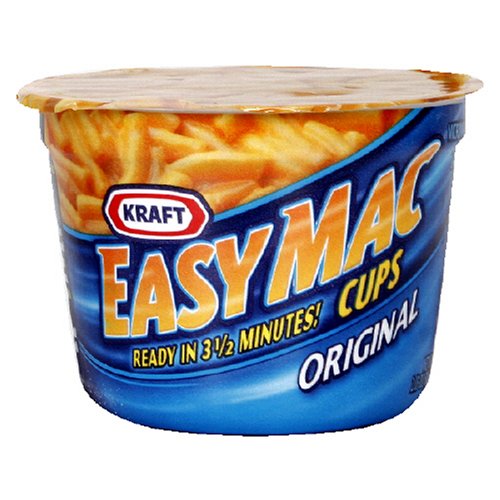
I always thought this was a nasty idea--what with the no milk and all--but regular Kraft Mac & Cheese tastes fake anyway, and Easy Mac (shockingly) tastes exactly the same. It only takes a few minutes to make and it has that same gross/good taste of the original. All you need is water and a microwave.
Easy Mac, the most ridiculous/useful snack/meal ever.
I always thought this was a nasty idea--what with the no milk and all--but regular Kraft Mac & Cheese tastes fake anyway, and Easy Mac (shockingly) tastes exactly the same. It only takes a few minutes to make and it has that same gross/good taste of the original. All you need is water and a microwave.
Easy Mac, the most ridiculous/useful snack/meal ever.
Subscribe to:
Posts (Atom)